This isn’t a sponsored post.
BrumHour saw The Resistible Rise of Arturo Ui at the invite of The RSC.
By David Fox @DavidFoxTheatre
The Resistible Rise of Arturo Ui at The RSC Swan Theatre
⭐⭐⭐⭐⭐”sharply satirical”
Directed by Seán Linnen, by By Bertolt Brecht translated by Stephen Sharkey
Arturo Ui: a small-time gangster in the big-city of Chicago. Set against the turmoil of the Great Depression, the play follows Ui, whose ruthless ambition propels him into a corrupt underworld of violence, scandal, and political decay. Exploiting fear and instability, he and his gang pose as protectors while tightening their grip through intimidation and backroom deals. As his influence spreads beyond the streets into markets, politics, and the law itself, Ui’s rise becomes increasingly dangerous, revealing a calculated march toward absolute power—while those around him remain either complicit or powerless to stop him.
The play is a sharply satirical allegory of Adolf Hitler’s rise to power, with each character and event mirroring real figures and incidents from Nazi Germany. Ui stands in for Adolf Hitler, while his associates reflect key members of the regime, including; Ernst Röhm, Hermann Göring, and Joseph Goebbels. The narrative closely parallels historical events, such as a warehouse fire echoing the Reichstag fire and territorial expansion reflecting the Anschluss into Austria. However, you don’t need to be an expert on German history to enjoy this production. Through this exaggerated retelling, the play exposes how manipulation, propaganda, and opportunism enabled the rise of totalitarian power. Bertolt Brecht fled Germany in February 1933, immediately after the Nazis took power, because his Marxist views, anti-fascist stance, and critical, satirical plays made him a prime target of the new regime.

This production marks a double-first – the RSC directorial debut of Seán Linnen, and the RSC acting debut of Mark Gatiss as the notorious Arturo Ui. Gatiss brings a formidable pedigree to the role of Ui, delivering a performance that showcases exactly why he is a double Olivier Awards winner. A brilliant polymath widely known for co-creating, writing, and starring in Sherlock, his extensive work on Doctor Who, and not forgetting The League of Gentlemen. There is something of the League’s trademark black humour here: Gatiss channels his versatility into a commanding stage turn, blending menace, wit, and precision to chart Ui’s chilling rise. It’s a performance of remarkable control and charisma, underlining the theatrical skill that has earned him top honours and confirming his status as one of Britain’s most accomplished stage actors.
Drawing on Brechtian theatre, the production makes full use of multi-roling, direct address, and fourth-wall breaks, allowing the supporting cast to demonstrate remarkable versatility throughout. Christopher Godwin stands out with a finely judged dual performance as Dogsborough and The Actor, shifting effortlessly between authority and theatrical self-awareness, while Joe Alessi impresses across multiple roles with sharp characterisation and fluidity. Most striking, however, is Santino Smith as Hook, delivering a menacing, deeply unsettling presence; his performance feels genuinely dangerous, creating a palpable tension that makes every one of his entrances feel threatening, even from the audience’s perspective – I was terrified every time he ventured near the audience!
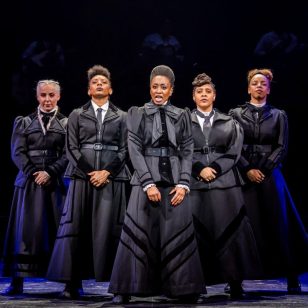
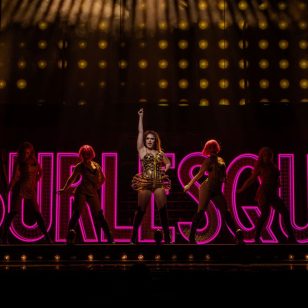
The supporting costumes evoke the aesthetic of the recent Cabaret revival, drawing on a queer, sexually ambiguous reimagining of 1930s Weimar Berlin that feels both decadent and unsettlingly modern. This fluid, provocative style contrasts strikingly with Ui himself: Mark Gatiss initially appears lank, grey, and almost cadaverous, his look deliberately drained of vitality. As Ui’s power grows, however, his costume evolves into a sharp, unsettling parody of Hitler’s uniform, visually charting his transformation from small-time crook to authoritarian figure and reinforcing the production’s darkly satirical edge.

Original music comes from a collaboration with British alternative rock band Placebo, whose original score drives the action with a jagged, confrontational energy, acting as an aggressive punctuation between scenes. Their signature blend of raw, punk-inflected guitar, glam-rock stylisation, and brooding, angst-laden soundscapes underscores the play’s themes of power, alienation, and moral decay. Rather than simply accompanying the action, the music crashes in to fracture transitions, jolting the audience and heightening the sense of unease, as if each scene change is a violent lurch forward in Ui’s relentless ascent.
Dark humour runs throughout, with some of the sharpest moments emerging from the play’s self-aware theatricality—most notably as Ui is schooled in public speaking through Julius Caesar, delivering speeches with exaggerated gravitas that slyly parody classical rhetoric. These sequences are laced with knowing Royal Shakespeare Company and Stratford in-jokes, delighting the audience! Leading to something far darker in the final stages, as Ui’s transformation is completed: dressed in a chilling evocation of Hitler’s military uniform and framed by stark, swastika-like imagery, the production transforms from satire to something profoundly unsettling.

The production closes with a chilling, unforgettable final moment as Mark Gatiss steps out of character, wipes away Ui’s Hitler-esque moustache, and directly addresses the audience. In this stark epilogue, he reminds us that while Ui may be invented, he is rooted in a very real and dangerous past—one that feels disturbingly present. The effect is deeply unsettling, culminating in an unforgettable line, “the bitch that bore him is in heat again!” a warning that lands with renewed urgency, leaving the audience with a haunting sense that the conditions which enabled such tyranny are never safely confined to the past.
A bold, imaginative, and dangerous reimagining, this production is a chilling wake-up call that feels not only urgent but vital. Unflinching in its vision and electric in its execution, it lingers long after the final scene—an uncompromising, total piece of theatre that confronts, provokes, and resonates in exactly the way the world needs right now. The Resistible Rise of Arturo Ui is at The Swan Theatre, Stratford-upon-Avon, until 30th May 2026. Discover what is coming up at The RSC here: rsc.org.uk/whats-on